
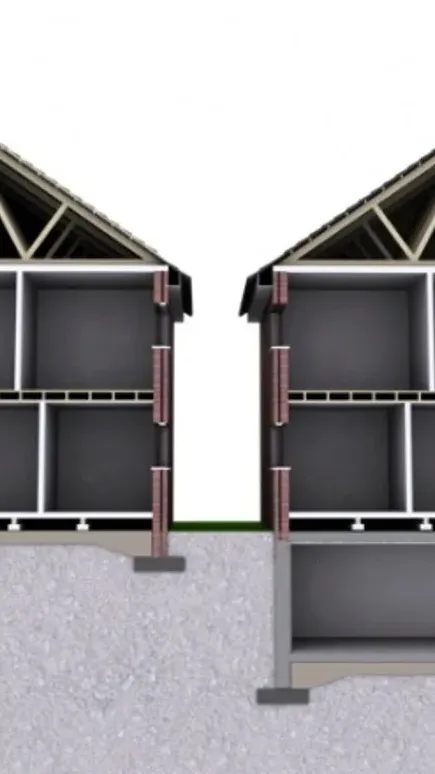
Party Wall surveyors for building and adjoining owners
We’re RICS-regulated party wall surveyors for building owners and adjoining owners, working from London and Essex across England and Wales. We serve party wall notices within five working days of instruction, record schedules of condition and agree party wall awards, from loft conversions and extensions to basements and city centre schemes.
What does a party wall surveyor do?
A party wall surveyor runs the process set out in the Party Wall etc. Act 1996 when building work affects a shared wall, the boundary or a neighbour’s foundations. They serve the notices, record the neighbouring property in a schedule of condition and agree a party wall award setting out how the work goes ahead.
Every surveyor appointed under the Act has to act impartially. The government’s explanatory booklet says surveyors must consider the interests of both owners, whoever appointed them.
Agreed surveyor
One party wall surveyor acts for both the building owner and the adjoining owner. It’s usually the quickest and cheapest route, and it works well where neighbours are on good terms.
Two surveyors
Each owner appoints their own party wall surveyor. The two agree the award between them, and at the start they select a third surveyor in case they can’t agree.
The third surveyor
The third surveyor is rarely called on. If the two appointed surveyors can’t agree a point, either of them, or either owner, can ask the third surveyor to decide it under section 10 of the Act.
When you need a party wall surveyor
You need a party wall surveyor when your work falls under the Act and your neighbour doesn’t simply consent in writing. Most projects on terraced and semi-detached houses fall under it, and so do most basements.
Loft conversions and extensions
Loft conversions usually cut steel beams into the party wall or raise it. Rear extensions often need a new wall on the boundary and footings deeper than the neighbour’s. Each of those needs a notice, and a party wall award if the neighbour dissents.
Basements and excavation near a neighbour
Digging within 3 metres of a neighbour’s building to below their foundations, or within 6 metres where the dig cuts a 45 degree line from their foundations, needs a notice of adjacent excavation. Basements and piling almost always do.
Work to a shared wall
Underpinning, raising or cutting into a party wall, inserting a damp-proof course and removing a chimney breast all need a party structure notice, served at least two months before work starts.
New walls on the boundary
Building a new wall on the boundary line, astride it or right up against it, needs a line of junction notice one month ahead. Garden walls that stand astride the boundary are covered too, so raising or rebuilding one needs a notice.
Send us the address and a line about the work. We’ll tell you what applies, how long it takes and what it costs.
What a party wall surveyor can't do
A party wall surveyor’s powers come from the Act, so they have limits. Surveyors can’t decide where a disputed boundary runs, and they can’t grant planning permission or building regulations approval, which are separate.
They also can’t make an award about work that was done without notice. In Power and Kyson v Shah, the Court of Appeal held that where no notice had been served, surveyors had no power to award on completed work. For work still to come, notice can be served at any point, and the Act applies from then.
How the party wall process works under the Act
Serving a party wall notice
The building owner serves notice on every adjoining owner: two months ahead for work to a party wall, one month for a new wall on the boundary or an excavation. We draft and serve notices within five working days of instruction. The neighbour then has 14 days to consent or dissent, and silence counts as dissent.
Schedules of condition
Before work starts, the surveyors record the condition of the adjoining owner’s property in notes and photographs. If damage appears later, the schedule of condition shows what was there before, which settles most arguments quickly.
The party wall award (party wall agreement)
The award, which most people call a party wall agreement, sets out the work allowed, the drawings, working hours, access, protection and who pays the surveyors’ fees. Either owner can appeal to the county court within 14 days of it being served. After that, it’s binding.
Acting for adjoining owners
If you’ve received a party wall notice, you can consent, dissent or ask for extra work in a counter notice. Most adjoining owners with structural work or deep digging next door choose to dissent and appoint a surveyor, and the building owner normally pays that surveyor’s reasonable fees.
As your surveyor, we check the drawings and method, record your property before work starts, agree protection and working hours in the award and deal with any damage that appears. If your neighbour has started work without a notice, write to them asking them to stop and serve one, and talk to us.
Being an adjoining owner doesn’t make you difficult. The Act gives you the right to a surveyor who protects your interests, and in most cases it costs you nothing, because the building owner pays. A clear award and a good schedule of condition protect both houses.

How much does a party wall surveyor cost, and who pays?
We don’t have a standard fee. We look at the drawings, the type of work and the number of adjoining owners, then quote for the job, so you know the cost before we start.
What drives the fee is time: the number of neighbours, one agreed surveyor or two, the complexity of the structural work and how complete the drawings are when notices go out. Basements and piling take more time than a loft conversion.
Under section 10(13), the surveyors decide who pays the costs of the award. Where the work is for the building owner’s benefit, that’s usually the building owner, including the adjoining owner’s surveyor. Our guide to party wall surveyor costs covers the detail.
Send us the address and a line about the work. We’ll tell you what applies, how long it takes and what it costs.
Why building owners instruct CHP
Our director, James Crowley, is a past London and National Chair of the Pyramus and Thisbe Society, which brings together people who work on party wall matters. We’ve acted on projects across the UK, from domestic extensions to large city centre developments.
That includes the more complicated methods of construction: temporary restraint works, piling to form a triple basement and jet grouting. We’ve also negotiated licences for scaffolding and tower cranes over neighbouring land. We’ve been doing this since 2004, we’re RICS regulated, and we work from offices in London SE1 and Wickford, Essex.
James is personally involved in every project we take on. The same small team serves the notices, inspects the property and agrees the award, so you deal with people who know your project from the first call to the final inspection.


Over the past four years, CHP have worked very successfully with us in their capacity as party wall surveyors. Through his calm, sensible approach and excellent communication skills James Crowley, in particular, gained the trust and confidence of the entire team and stakeholders. Looking forward to working with CHP again.”
- Clare Goggin, Jackson Coles
Case Studies
Vincent Place, Southampton
Services Provided
- Initial Site Appraisal
- Daylight + Sunlight Report
- Party Wall Negotiations
- Pre-Acquisition strategic advice
28 Cardozo Road, London, N7
Services Provided
- Daylight + Sunlight Analysis
- Overshadowing Analysis
- Daylight + Sunlight Report
- Preliminary advice regarding the Party Wall etc. Act 1996
- Assessment of proposed accommodation’s access to daylight and sunlight
Empire Wharf, London, E9
Services Provided
- Daylight + Sunlight Report
- A point of contact with the existing leaseholders
- Acting as the Building Owner’s Surveyor under the Party Wall etc. Act 1996
Party Wall FAQs
Are your party wall surveyors RICS regulated?
Yes. CHP Surveyors is regulated by RICS, and our party wall work follows the Party Wall etc. Act 1996. Our director, James Crowley, is a past London and National Chair of the Pyramus and Thisbe Society.
How quickly can you serve a party wall notice?
Within five working days of instruction, once we have the drawings and the details of the adjoining owners. The notice period then runs from the date of service: two months for work to a party wall, one month for excavations.
Can you act for my neighbour and me?
Yes, as an agreed surveyor, if you both agree. We act impartially between the two owners, as the Act requires. If your neighbour would rather have their own surveyor, we can act for one of you instead.
Do I need a party wall surveyor for a loft conversion?
On a terraced or semi-detached house, usually. Steel beams in the party wall or raising the wall need a party structure notice. If your neighbour consents in writing, no surveyor is needed. If they dissent, surveyors agree an award.
Where do your party wall surveyors work?
Across London from our office in SE1, across Essex from our office in Wickford, and throughout England and Wales. The Act doesn’t apply in Scotland or Northern Ireland, which have their own rules.

Talk to a party wall surveyor
Send us the address, the drawings if you have them and a line about the work. We’ll tell you which notices apply, how long it takes and what it costs.
Get in touch.
Head Office
2-6 Boundary Row
London, SE1 8HP
Essex Office
2nd Floor, 10 High Street
Wickford, Essex
SS12 9AZ
020 3714 4090
enquiries@chpsurveyors.com